

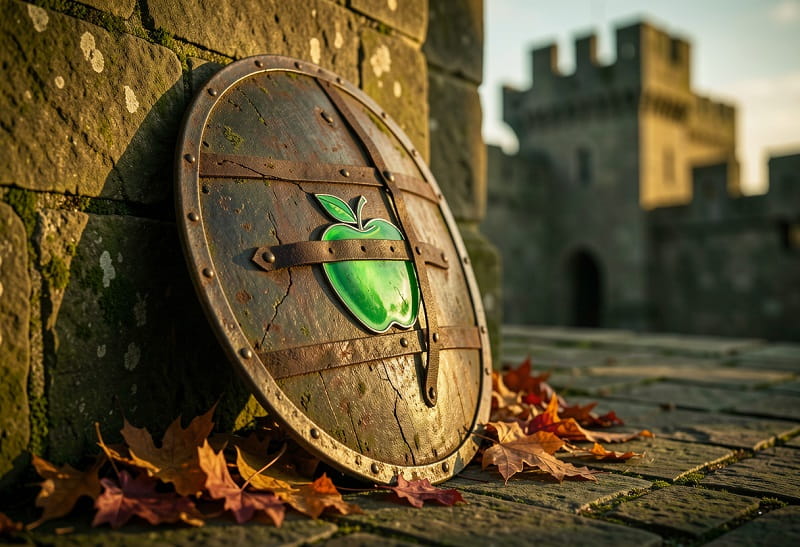
Raymun Fossoway is one of the most quietly compelling figures in the world George R.R. Martin built — a knight whose decision to change the color of an apple on his sigil became one of the most memorable acts of conscience in Fire & Blood and House of the Dragon. The Green Apple Knight is not a king, not a Hand, and not a dragonrider. What makes Raymun Fossoway worth understanding is precisely that he is an ordinary knight who refuses to do an ordinary wrong thing — and pays a price for it that reshapes his family’s identity forever.
The Fossoway family hails from the Reach, one of the great houses of Westeros. Their sigil is traditionally a red apple on white — a heraldic image tied to their lands and identity. When Raymun’s cousin Ser Steffon Fossoway refuses to honor a debt of loyalty during the Trial of Seven in The Hedge Knight, Raymun makes a public break. He declares that he will no longer bear the same apple as a man who acts without honor. From that moment, the line splits — red apple Fossoways and green apple Fossoways — each branch carrying the weight of that single act of defiance.
Who Is Raymun Fossoway in the ASOIAF Timeline
Raymun Fossoway first appears in “The Hedge Knight,” the first of George R.R. Martin’s Tales of Dunk and Egg novellas. The story is set roughly ninety years before the events of A Game of Thrones, during the reign of King Daeron II Targaryen. This makes it a prequel not just to the main series but also to House of the Dragon, which itself takes place about 170 years before the War of Five Kings.
Understanding where Raymun sits in the timeline matters because it contextualizes the Green Apple Fossoway name that appears in later material. The branch he founds carries his decision forward for generations. In House of the Dragon, the Fossoways — both branches — appear as lords of the Reach aligned with various factions during the Dance of the Dragons, the Targaryen civil war at the center of the show. The green apple branch owes its existence entirely to what Raymun did at Ashford Meadow.
The Trial of Seven at Ashford Meadow
The trial in “The Hedge Knight” centers on Dunk — a young hedge knight who later becomes Ser Duncan the Tall, Lord Commander of the Kingsguard — and his squire, a boy named Egg who is secretly Prince Aegon Targaryen. Dunk gets into an altercation with Prince Aerion Targaryen, a cruel and volatile man who attacks a puppeteer troupe. Dunk defends the girl and strikes the prince.
In Westeros, striking a prince is a crime that carries severe consequences. Prince Aerion calls for a Trial of Seven — a form of trial by combat where each side must field exactly seven knights. Dunk, a hedge knight of no great reputation, must find six men willing to risk their lives fighting alongside him against a Targaryen prince and his allies. This is a nearly impossible ask for a man with no name, no wealth, and no lord’s banner to stand behind.
Steffon Fossoway, a red apple knight, initially pledges to fight with Dunk. He is a capable fighter and his commitment seems firm. But as the reality of fighting a Targaryen becomes clearer, Steffon withdraws. He invents reasons, hedges, and ultimately refuses to honor his word. It is a cowardly act dressed in practical logic — the kind of retreat that powerful people make when loyalty becomes inconvenient.
Raymun is Steffon’s cousin. He is a younger man, not yet knighted, and he has less to gain and arguably more to lose by stepping forward. But it is precisely Raymun who stands up. He offers himself to fight alongside Dunk, knowing that the odds are brutal and that opposing a Targaryen prince is not a decision that goes unnoticed. His willingness to go where his cousin would not defines his entire character in a single scene.
The Green Apple Decision Explained
After the Trial of Seven concludes — Dunk survives, Prince Aerion is exiled, and the battle costs several lives on both sides — Raymun makes his declaration. He will not bear the same sigil as Steffon Fossoway. He announces that he is a green apple Fossoway now, distinguishing himself from his cousin’s red apple line. The color change is not a formal heraldic procedure. It is an improvised act of public identity, a way of saying that the two men cannot share the same symbol after what Steffon did.
This moment resonates because heraldry in Westeros is not decorative — it is identity. A sigil is a house, a bloodline, a reputation. To split the apple is to split the family’s moral record, to say that honor is more fundamental than blood. Raymun creates a new branch not because he wins anything or gains land or title, but because he refuses to be associated with a man who broke his word in the worst possible moment.
Raymun Fossoway’s Role in House of the Dragon
In House of the Dragon, the show set during the Dance of the Dragons roughly sixty years after “The Hedge Knight,” the Fossoway name reappears. Both branches — red apple and green apple — exist in Westeros as a direct consequence of Raymun’s decision. The green apple Fossoways are a functioning noble house of the Reach, carrying their founder’s name and the story it implies.
During the Dance of the Dragons, the Reach becomes a contested region. Its lords are largely aligned with the Hightowers and, through them, with the greens — the faction supporting King Aegon II. The Fossoway lords appear in the broader alignment of Reach lords rather than as central characters, but their presence confirms that the family line established by Raymun persisted through nearly a century of Westerosi history.
For viewers who encounter the name “green apple Fossoways” in House of the Dragon without having read “The Hedge Knight,” the reference can seem puzzling. Why does a house need two branches defined by fruit color? The answer is Raymun — and what he did at Ashford Meadow.
Ser Duncan the Tall and the Egg Connection
Raymun Fossoway’s significance cannot be fully separated from his relationship to Dunk and Egg. Dunk, the hedge knight he fights beside, becomes one of the most celebrated figures in Westerosi history. He eventually rises to Lord Commander of the Kingsguard under King Aegon V — the boy named Egg who stood at Dunk’s side during the trial. The two men are eventually memorialized in tapestries in Winterfell, their faces worn away by time, but their legend preserved.
Raymun’s decision to fight alongside Dunk is, in retrospect, a decision to stand with history. He does not know that Egg is a Targaryen prince during much of the trial’s buildup. He is simply choosing a hedge knight who seems to be in the right over a cousin who is choosing comfort over commitment. That instinct — choosing principle over convenience — is exactly the quality that the Egg and Dunk stories consistently reward.
The Tales of Dunk and Egg are a recurring exploration of what genuine honor looks like in a world where honor is frequently invoked by people who do not practice it. Raymun Fossoway is a supporting example of that theme: a minor character who gets one decision right, and whose entire family tree grows out of that single right decision.
The Fossoway Family Tree: Red Apple vs Green Apple
After the split, the Fossoway name continues on both sides. The red apple Fossoways remain the elder line, holding whatever lands and titles the family possessed before the split. The green apple Fossoways, descended from or associated with Raymun, carry their distinction forward as a point of pride rather than shame.
By the time of A Song of Ice and Fire — the events of the main series and Game of Thrones — both branches still exist. They do not occupy major roles in the political drama of the War of Five Kings, but their continued existence is itself a quiet argument for the durability of the choice Raymun made. A house founded on refusing to share a traitor’s sigil has lasted for generations.
In the broader world of Westerosi noble families, the Fossoway split is unusual because it is openly documented as a moral rupture rather than a political one. Most noble house divisions involve succession disputes, inheritance conflicts, or battlefield allegiances. The Fossoway split is about what a man did when someone needed help and his cousin refused. That is rarer, and it is why readers and viewers remember the Green Apple Knight.
What the Green Apple Represents Thematically
Martin uses heraldry throughout ASOIAF as a narrative tool. A direwolf, a lion, a stag — these are not just decorations. They tell you something about how a house sees itself and how the world sees them. The apple, as a sigil, has connotations of abundance, the Reach’s agricultural wealth, and a certain domestic peace. Splitting it in two — red and green — adds a dimension the original never had: the idea that the same object can carry two completely different moral legacies depending on whose hands hold it.
The green apple Fossoways are living proof that institutional identity can be rebuilt from a single act of conscience. Raymun does not wait for permission or a lord’s endorsement. He does not petition the College of Heralds. He simply declares who he is, different from who his cousin is, and the world accepts it because he demonstrates with his body — in the Trial of Seven — that his claim is real.
Frequently Asked Questions About Raymun Fossoway
Why did Raymun Fossoway change his sigil from red to green?
Raymun changed his sigil’s apple color from red to green after his cousin Steffon Fossoway refused to honor his pledge to fight alongside Dunk at the Trial of Seven in “The Hedge Knight.” Steffon’s refusal was an act of cowardice, and Raymun publicly declared he would no longer bear the same symbol as a man without honor. The green apple became the sigil of a new branch of the Fossoway family founded on that distinction.
Is Raymun Fossoway in House of the Dragon?
Raymun himself is not — he lived roughly ninety years before the events of House of the Dragon. However, the green apple Fossoway family he founded appears in the show’s world as one of the Reach noble houses during the Dance of the Dragons. The name survives because of what Raymun did at Ashford Meadow.
What is the Trial of Seven in Game of Thrones lore?
The Trial of Seven is an ancient form of trial by combat in which each side fields exactly seven knights, reflecting the Faith of the Seven. It was rarely invoked by the time of the main series and is largely historical by the era of A Game of Thrones. In “The Hedge Knight,” Prince Aerion Targaryen calls for one against Dunk, forcing the young hedge knight to find six champions willing to fight beside him against a prince’s chosen warriors.
Who wrote The Hedge Knight and where can you read it?
George R.R. Martin wrote “The Hedge Knight” as part of his Tales of Dunk and Egg series. It first appeared in the 1998 anthology Legends edited by Robert Silverberg. It has since been collected in A Knight of the Seven Kingdoms, a single volume containing the first three Dunk and Egg novellas. A companion graphic novel adaptation also exists for readers who prefer an illustrated format.
Are the Fossoways major characters in A Song of Ice and Fire?
No — the Fossoway family is a minor noble house of the Reach. They appear in background lists of lords and in Reach military contingents, but neither branch is a central POV house in the main series. Their significance is greatest in the Dunk and Egg material, where the founding of the green apple branch is depicted in detail.
What happened to Ser Steffon Fossoway after the Trial of Seven?
Steffon Fossoway survives the trial but carries the reputation of having broken his word to a man who needed him. His actions are recorded in “The Hedge Knight” as a clear example of choosing personal safety over honor. The red apple branch he represents continues, but the narrative treats his behavior as a permanent mark against the branch — the contrast with Raymun’s green apple line is the point Martin is making.
Pro Tips for Understanding the Fossoway Connection to House of the Dragon
Reading “The Hedge Knight” before or alongside House of the Dragon dramatically enriches understanding of the Reach’s noble houses. The green apple Fossoway name will appear in passing references, and knowing its origin transforms it from a confusing heraldic detail into a piece of living history. Martin structures his world so that small details reward research — the apple colors are a prime example.
Pay attention to how the show House of the Dragon Season 3 continues to develop the Reach lords as a faction. The Hightower alignment of the Reach greens pulls multiple houses into the civil war, and Fossoway names may appear in battle rosters or alliance lists that will carry more weight for viewers who understand the family’s divided history.
When watching shows that emphasize character morality and loyalty rankings, the Fossoway split offers a useful framework: the same house, the same blood, the same starting conditions — two completely different moral legacies. Martin uses this to argue that individual choices, not heredity, are what build a family’s actual identity over time.
The Tales of Dunk and Egg were planned by Martin to total nine novellas, each covering a different period of Dunk and Egg’s years together. Only three have been published as of current knowledge. The story of how Dunk and Egg’s legends are transmitted across generations — and how small characters like Raymun become part of a broader mythology — is precisely what Martin is building toward in the larger project.
The A Knight of the Seven Kingdoms TV adaptation, developed at HBO, has been in production as a separate series from House of the Dragon. It covers the Dunk and Egg stories directly, meaning Raymun Fossoway’s trial scene — the moment the green apple is born — is likely to appear on screen. For viewers who know the best prestige TV series tend to reward prior reading, the Dunk and Egg novellas are among the most accessible entry points into extended ASOIAF lore.
Raymun Fossoway is proof that a supporting character with one scene can anchor a family’s identity for a century of in-world history. He is not remembered for a battle won or a war ended. He is remembered for saying: I am not the same as the man standing next to me, and here is my sigil to prove it. In a world built on the weight of names and symbols, that is its own kind of power — and it is exactly the kind of storytelling that distinguishes the Dunk and Egg material from the broader dynastic sprawl of ASOIAF.

Loading comments…