

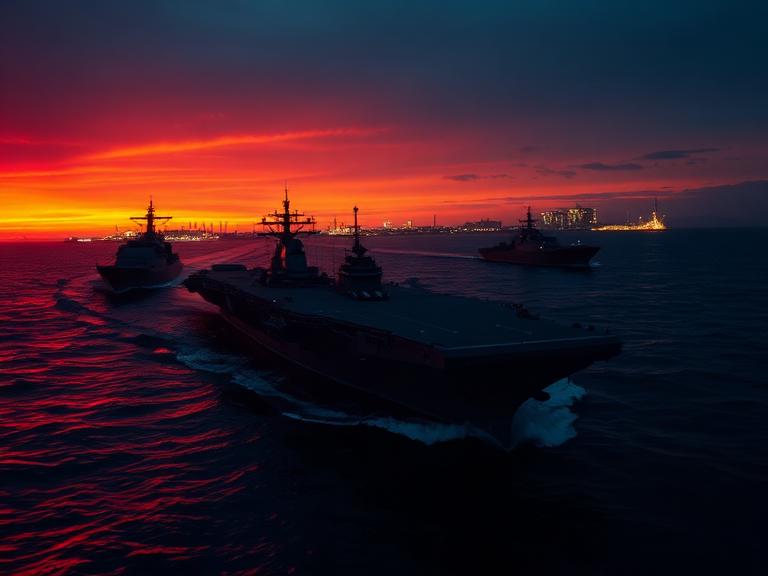
The United States Department of Defense has accelerated the deployment of advanced naval assets and aerial strike groups to the Persian Gulf this week, citing credible intelligence of increased regional threats to commercial shipping and energy infrastructure. This strategic movement, which includes the repositioning of an integrated carrier strike group and additional missile defense batteries, aims to deter potential aggression while simultaneously raising concerns regarding the immediate stability of global oil benchmarks. Defense officials confirmed on Thursday that the maneuvers are a direct response to a series of coordinated maneuvers by regional actors that threaten the free flow of commerce through the Strait of Hormuz, a critical chokepoint through which approximately twenty percent of the world’s daily petroleum consumption passes.
The military buildup represents one of the most significant shifts in regional force posture in recent years, reflecting a heightened state of readiness among Western allies. Pentagon spokesperson Major General Patrick Ryder stated during a press briefing that the United States remains committed to protecting its interests and those of its international partners against any maritime provocations. This escalation follows several weeks of diplomatic friction and reported drone activity near coalition bases, prompting a rapid reassessment of security protocols across the Arabian Peninsula. Military analysts suggest that the presence of these assets serves as a dual-purpose mechanism: providing a robust defense for energy corridors and serving as a high-visibility deterrent against unconventional warfare tactics.
Energy markets responded almost immediately to the news of the deployment, with Brent Crude and West Texas Intermediate futures experiencing a sharp uptick in intraday trading. Analysts from major financial institutions have warned that while current supply levels remain adequate, the “geopolitical risk premium” is being priced back into the market with renewed intensity. The uncertainty surrounding the duration of the military presence and the potential for miscalculation on either side has led to increased volatility in energy-heavy portfolios. Experts point out that any sustained disruption in the Gulf would likely trigger a rapid inflationary spike in fuel prices across Europe and North America, complicating existing efforts by central banks to stabilize global economies.
Senior Fellow for Middle East Studies at the Council on Foreign Relations, Steven Cook, emphasized the delicacy of the current situation during an interview with international media. “What we are witnessing is a classic security dilemma where defensive preparations by one party are viewed as offensive provocations by another, narrowing the window for diplomatic de-escalation,” Cook noted. He further explained that the integration of cyber warfare capabilities alongside traditional naval power has created a multi-domain theater where the risk of unintended escalation is higher than in previous decades. The international community is now closely monitoring the movements of both the U.S. Fifth Fleet and regional maritime forces to gauge the likelihood of a direct encounter.
The geopolitical significance of the Strait of Hormuz cannot be overstated, as it remains the primary artery for the export of crude oil from the world’s largest producers. Any military engagement in this narrow waterway would necessitate the rerouting of tankers, significantly increasing insurance premiums and shipping costs globally. Historical precedents show that even the threat of a closure can cause panic buying in the energy sector. To mitigate these risks, the U.S. has been coordinating with the International Maritime Security Construct, a coalition of nations dedicated to maintaining order and security in the Persian Gulf, the Gulf of Oman, and the Bab el-Mandeb Strait. These coordinated patrols are designed to provide a “protective umbrella” for civilian vessels navigating these contested waters.
In addition to naval movements, the U.S. Air Force has reportedly increased its sorties in the region, utilizing advanced surveillance platforms to monitor troop movements and missile launch sites. According to a report by the Associated Press, satellite imagery has detected an uptick in activity at several regional military installations, suggesting that regional powers are also hardening their defenses in anticipation of a prolonged standoff. This atmospheric tension has led to a flurry of diplomatic activity, with intermediaries from several neutral nations attempting to facilitate back-channel communications. The goal is to establish a “red line” protocol that could prevent a minor tactical error from spiraling into a wider regional conflict that neither side currently appears to desire.
The economic ramifications of this military buildup extend far beyond the gas pump. Global supply chains, already strained by logistical challenges in other parts of the world, are highly sensitive to the stability of the Middle East. High-energy industries, such as manufacturing and aviation, are particularly vulnerable to the fluctuations in oil prices caused by these security concerns. Economists at the International Monetary Fund have previously cautioned that a ten percent increase in the price of oil can lead to a measurable reduction in global GDP growth over a twelve-month period. Consequently, the current military posturing is being viewed not just through a lens of national security, but as a critical factor in global macroeconomic forecasting for the remainder of the fiscal year.
The U.S. State Department has issued updated travel advisories for several countries in the region, urging citizens to exercise increased caution due to the “volatile security environment.” Simultaneously, American diplomats have been working to reassure allies in the Gulf that the military buildup is intended to be a stabilizing force rather than a precursor to offensive operations. Secretary of State Antony Blinken has held multiple high-level consultations with his counterparts in Riyadh, Abu Dhabi, and Doha to synchronize regional responses. These discussions have focused on enhancing intelligence sharing and developing a unified stance against maritime interference, which the U.S. argues is essential for maintaining the international rules-based order.
Regional reactions to the deployment have been predictably varied. While some nations have welcomed the increased security presence as a necessary counterweight to recent provocations, others have criticized the move as an unnecessary “militarization” of the Gulf that risks provoking the very conflict it seeks to prevent. A spokesperson for the Iranian Foreign Ministry described the arrival of additional U.S. assets as “adventurism” that threatens the sovereignty of regional states. This rhetorical exchange underscores the deep-seated mistrust that characterizes the relationship between Washington and Tehran, a divide that has only widened since the collapse of previous nuclear and security frameworks. The absence of a direct hot-line between the two military commands remains a primary concern for observers worried about rapid escalation.
The role of technology in the current buildup is a significant departure from previous eras of Gulf tensions. Both sides have integrated sophisticated unmanned aerial vehicles (UAVs) and electronic warfare suites into their operational planning. These technologies allow for persistent surveillance and the ability to disrupt enemy communications without committing traditional manned platforms. However, the use of drones also introduces new risks, as they can be deployed by non-state actors or third parties to create “false flag” events designed to draw major powers into a confrontation. Defense analysts emphasize that verifying the origin of any kinetic strike in this environment has become increasingly difficult, requiring a high degree of technical attribution before military responses can be justified.
Looking at the broader strategic landscape, the U.S. military presence in the Middle East is also influenced by global competition with other superpowers. While the immediate focus is on regional threats, the Pentagon is also mindful of the increasing naval presence of China and Russia in the Indian Ocean. The ability of the United States to rapidly surge forces into the Persian Gulf serves as a demonstration of its logistical reach and its role as the ultimate guarantor of maritime security. This “over-the-horizon” capability is a central pillar of the National Defense Strategy, which emphasizes the need for flexible and mobile forces that can respond to crises in multiple theaters simultaneously.
Internal political pressures within the United States are also playing a role in how the administration manages this crisis. With an election cycle on the horizon, the impact of oil prices on domestic inflation is a highly sensitive topic. The administration is under pressure to show strength against foreign adversaries while avoiding a costly and unpopular military entanglement. This domestic balancing act often dictates the “rhythm” of deployments and the tone of public statements. Critics in Congress have called for a more defined strategy regarding the long-term presence of U.S. troops in the region, arguing that without a clear diplomatic endpoint, the military risks being caught in an endless cycle of deterrence and reaction.
The insurance industry is another sector feeling the immediate impact of the military buildup. The Joint War Committee, which represents the interests of London’s marine insurance market, has maintained the Persian Gulf on its list of high-risk areas. Shipowners are now facing “war risk” premiums that can add hundreds of thousands of dollars to the cost of a single voyage through the Strait of Hormuz. These costs are ultimately passed down to consumers, contributing to the rising cost of goods globally. To counter this, some nations have considered providing sovereign guarantees or naval escorts for their own national-flagged vessels, a move that would further complicate the maritime security environment by introducing more naval actors into a confined space.
The humanitarian implications of a potential conflict in the region are also a significant concern for international organizations. The Middle East is home to some of the world’s most vulnerable populations, many of whom rely on stable energy exports to fund basic social services. A major disruption in the oil market would not only impact the wealthy nations of the West but would be devastating for developing economies that lack the strategic reserves to weather a price shock. Organizations like the United Nations have called for all parties to exercise maximum restraint, highlighting that the collateral damage of a regional war would extend far beyond the immediate combatants, affecting food security and economic stability on a global scale.
The tactical nature of the buildup includes the deployment of the USS Gerald R. Ford carrier strike group, which brings unprecedented electronic warfare and strike capabilities to the theater. This is complemented by the arrival of specialized Marine units trained in maritime raid and recovery operations. These units are specifically equipped to board and secure vessels that may have been illegally seized or disabled in the waterway. The integration of these high-end capabilities is intended to signal that the U.S. possesses a full spectrum of responses, ranging from non-kinetic electronic disruption to high-intensity combat operations. This “calibrated pressure” is designed to force regional actors to reconsider the costs of continued provocation.
Historical analysis of similar military buildups in the 1980s during the “Tanker War” phase of the Iran-Iraq conflict provides some insight into how the current situation might evolve. During that period, the U.S. launched Operation Earnest Will to protect Kuwaiti tankers, leading to direct but limited naval engagements. Today, however, the weaponry is much more precise and the speed of information is instantaneous. This means that while the U.S. has a greater ability to control the “ladder of escalation,” the political and economic consequences of any single incident are magnified. The current strategy appears to be a modern iteration of that era’s containment policy, updated for an age of cyber threats and globalized energy markets.
Intelligence agencies are currently operating at a high tempo, attempting to distinguish between routine military exercises and genuine preparations for an attack. The ambiguity of “gray zone” tactics—actions that fall below the threshold of open warfare but still challenge the status quo—makes this task particularly difficult. For example, the placement of naval mines or the use of small, fast-attack boats to harass tankers are tactics that can be denied or attributed to rogue elements. To combat this, the U.S. has increased its investment in underwater surveillance technology and maritime domain awareness, aiming to “strip away the veil of deniability” that regional actors often rely upon during maritime incidents.
Global energy giants such as Saudi Aramco, BP, and Shell are also taking independent steps to protect their assets. Many have increased security at land-based pumping stations and offshore platforms, recognizing that these facilities are high-value targets in any regional conflagration. The vulnerability of digital infrastructure is also a major concern, as a cyberattack on a major refinery or pipeline could be just as disruptive as a physical strike. This has led to a closer partnership between the private energy sector and national security agencies, with a focus on creating “redundant systems” that can survive a localized disruption without causing a total collapse of the supply chain.
The diplomatic stalemate is further complicated by the internal dynamics of the regional powers themselves. Hardline factions within several governments may see a confrontation as a way to consolidate domestic power or distract from economic failings. Conversely, more moderate elements are wary of the devastating consequences of a war and are quietly advocating for a return to the negotiating table. The U.S. strategy of military buildup is partly intended to empower these moderate voices by demonstrating that the path of escalation is a “dead end” that will only result in overwhelming military and economic pressure. Whether this strategy will be successful remains one of the most debated questions in foreign policy circles today.
As the military buildup continues, the focus remains on the “Flashpoint Index”—a set of indicators used by analysts to predict the likelihood of an imminent clash. These indicators include the movement of mobile missile launchers, the hardening of command-and-control centers, and the evacuation of non-essential personnel from sensitive areas. While none of these indicators have reached a “critical” level as of yet, the trend line is clearly moving toward a more volatile state. International monitors from the International Atomic Energy Agency (IAEA) also play a role, as the link between regional security and nuclear proliferation remains a central theme in the broader geopolitical contest.
Environmental concerns are also part of the strategic calculus. The Persian Gulf is a shallow and ecologically sensitive body of water. A major oil spill resulting from an attack on a tanker or an offshore rig would be an environmental catastrophe of historic proportions, affecting desalination plants that provide drinking water for millions of people in the region. The threat of “environmental warfare”—where a party intentionally causes an ecological disaster to punish an opponent—is a dark possibility that regional planners must account for. This adds an additional layer of urgency to the efforts to maintain peace, as the stakes involve the very basic survival of the region’s populations.
The current situation also tests the cohesion of the Western alliance. While the U.S. and the UK have been the most active in increasing their military presence, other European nations have been more cautious, preferring a “diplomacy-first” approach. This difference in style can sometimes lead to mixed messages that adversaries may attempt to exploit. However, the common interest in keeping the Strait of Hormuz open usually forces a degree of operational unity when the threat becomes tangible. The recent formation of the European-led Maritime Awareness in the Strait of Hormuz (EMASoH) is an example of how allies are attempting to contribute to regional security through independent but de-conflicted missions.
One of the more overlooked aspects of the military buildup is the role of the global banking system. Major financial institutions have their own “intelligence units” that monitor regional tensions to manage their exposure to emerging market debt. A war in the Middle East would likely lead to a flight to safety, with investors pouring capital into the U.S. dollar and gold, while divesting from currencies and equities in the region. This financial pressure serves as a “soft power” deterrent, as the mere prospect of economic isolation can be a powerful motivator for state actors to avoid a catastrophic conflict. The integration of financial sanctions into the broader military strategy remains a hallmark of modern American statecraft.
In the coming days, all eyes will be on the scheduled rotations of the naval groups and the public statements from regional leaders. If the buildup succeeds in its goal of deterrence, we may see a gradual drawdown and a return to the diplomatic “status quo.” However, if the provocations continue, the current deployments could be just the first phase of a much larger and more dangerous operation. The margin for error is razor-thin, and the consequences of a mistake are measured in both lives and the stability of the global economy. For now, the world remains in a state of watchful waiting, hoping that the high-stakes game of military chess in the Persian Gulf does not turn into a real-world battlefield.
The long-term trajectory of this standoff will likely depend on whether a new regional security framework can be established. Many analysts argue that the current system of “crisis management” is unsustainable and that a more permanent solution—perhaps involving a multilateral treaty on maritime safety—is needed. Until such a breakthrough occurs, the pattern of military buildup followed by temporary de-escalation is likely to repeat. The resilience of the global oil market will continue to be tested by these cycles of tension, requiring constant vigilance from both military commanders and market participants alike. The ultimate goal remains a region where the free flow of energy and commerce is guaranteed not by the presence of carrier strike groups, but by a shared commitment to international law and stability.
Conclusion
The ongoing military buildup in the Middle East and the resulting volatility in global oil prices underscore the intricate link between regional security and the world economy. As the United States and its allies deploy advanced assets to deter maritime provocations, the international community remains balanced on a fine line between effective deterrence and unintended escalation. The geopolitical risk premium currently being priced into energy markets reflects a deep-seated anxiety regarding the stability of the Strait of Hormuz and the potential for a localized incident to trigger a global economic shock. While military presence provides a necessary shield for commercial shipping, it is the underlying diplomatic efforts and the adherence to international maritime norms that will ultimately determine the long-term peace of the region. Moving forward, the global community must remain vigilant, as the evolution of technology and the complexity of multi-domain warfare have ensured that the stakes in the Persian Gulf are higher than ever before, requiring a sophisticated blend of strength and restraint to navigate the challenges ahead.

Loading comments…