
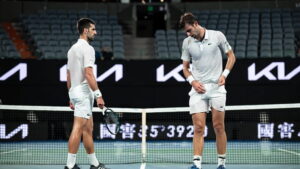
The Australian Open 2026 delivered a moment of high drama in the men’s quarterfinals on January 28 when Lorenzo Musetti, the No. 5 seed, was forced to retire due to injury while holding a commanding two-set lead over Novak Djokovic. The match, played on Rod Laver Arena, saw the 23-year-old Italian dominate the early stages before an upper right leg issue halted his progress. Djokovic, the top seed and 10-time champion at Melbourne Park, advanced to his 13th Australian Open semifinal under unexpected circumstances.
Musetti’s retirement came after he had established complete control, showcasing exceptional variety and defensive prowess against one of the sport’s all-time greats. The outcome underscored the unpredictable nature of professional tennis, where physical setbacks can abruptly alter the course of a high-stakes contest. This development propelled Djokovic forward despite his own challenges during the match, including a foot blister that required medical attention.
The quarterfinal represented a significant opportunity for Musetti to reach his first Australian Open semifinal and potentially climb to No. 3 in the live rankings. Instead, the abrupt end left him visibly devastated, marking the third time in recent Grand Slam events that injury has denied him a deep run at a crucial juncture. For Djokovic, the advancement maintained his pursuit of an 11th title in Melbourne and a record 25th Grand Slam crown.
Match Recap: A Tale of Dominance and Disruption
The contest began with Djokovic showing early intent, using his experience to apply pressure and secure an initial break. Musetti quickly responded, leveling the first set at 2-2 before surging ahead with precise shot-making. His one-handed backhand and tactical variety disrupted Djokovic’s rhythm, leading to multiple unforced errors from the Serb. Musetti capitalized on these opportunities, breaking serve again to close out the first set 6-4 after overcoming an early 0-2 deficit.
In the second set, Musetti continued his strong form, breaking Djokovic in the opening game and maintaining composure throughout. Djokovic struggled to find consistency, committing errors under sustained pressure from Musetti’s defense-to-offense transitions. The Italian extended his lead by taking the second set 6-3, leaving Djokovic searching for answers. At this stage, Musetti had broken Djokovic’s serve five times across the first two sets, demonstrating superior execution in key moments.
Early in the third set, the momentum shifted subtly. Djokovic managed to break back, but Musetti’s physical condition deteriorated. The Italian called for medical attention after the third game, receiving treatment on his upper right leg. Despite attempting to continue, the pain intensified, culminating in a double-fault that handed Djokovic another opportunity. Unable to proceed, Musetti walked to the net, shook hands with Djokovic, and retired with the score at 6-4, 6-3, 1-3 in favor of the Italian.
Key Moments of the Quarterfinal Encounter
- Musetti overcame an early 0-2 deficit in the first set by regaining composure and breaking Djokovic’s serve to level at 2-2. This adjustment allowed him to dictate play with varied shot selection, ultimately securing the set 6-4. His ability to absorb pressure and counter effectively set the tone for the match.
- The second set saw Musetti break immediately in the first game, establishing a lead he never relinquished. Djokovic’s unforced errors accumulated as Musetti’s defense forced extended rallies. The Italian closed the set 6-3, having broken serve multiple times and showcasing outstanding court coverage.
- Djokovic received treatment for a foot blister at the end of the second set, which required re-taping. This medical timeout briefly interrupted play, but Musetti maintained focus and continued his aggressive approach into the third set. The blister contributed to Djokovic’s discomfort but did not prevent him from competing.
- Musetti felt initial discomfort in his upper right leg early in the second set, though he persisted due to his strong performance. The issue worsened in the third set after he was broken in the third game. He took a medical timeout at 1-2 but could not regain mobility.
- At 1-3 in the third set, Musetti served a double-fault on break point, signaling the end of his resistance. Overwhelmed by pain, he clasped his face, removed his headband, and approached the net to retire. This moment ended the match after 2 hours and 8 minutes.
- Djokovic expressed immediate sympathy, acknowledging Musetti’s superiority throughout the contest. The Serb highlighted the Italian’s quality and variety, admitting he had been on the verge of defeat. This gesture reflected the mutual respect between the players despite the unfortunate conclusion.
- Musetti’s retirement marked a rare occurrence in the Open Era, as it was the first time a player retired in a major quarterfinal after winning the first two sets. The incident highlighted the fragility of performance at the elite level when injuries intervene.
- The match outcome advanced Djokovic to the semifinals, where he surpassed Roger Federer’s record for most Australian Open singles wins with 103 victories. This milestone added historical significance to an otherwise challenging path through the draw.
The Injury and Its Impact
Musetti first noticed something unusual in his upper right leg at the beginning of the second set. He chose to continue playing, encouraged by his excellent level and belief that the issue might resolve. However, the pain escalated progressively, reaching a point where movement became severely restricted during the third set.
Following the break in the third game of the deciding set, Musetti requested a medical timeout for treatment. The physio attended to his leg, but the discomfort persisted at an increasing intensity. When play resumed, Musetti attempted to serve and rally but found the condition unmanageable, leading to his retirement shortly thereafter.
In post-match comments, Musetti described the injury as a suspected issue in the adductor area, though he deferred final diagnosis to medical examinations upon returning home. He emphasized the frustration of undergoing pre-season testing to prevent such problems, only to encounter one at a critical moment. This was not an isolated incident for Musetti, who has faced similar setbacks in previous Grand Slams.
Player Reactions and Reflections
Lorenzo Musetti appeared deeply affected by the outcome in his post-match press conference. He expressed profound disappointment, stating that the retirement while leading two sets to love against Novak Djokovic was something he had never imagined. Musetti described the experience as the hardest loss of his career, highlighting the emotional toll of being in full control only to be forced out by injury.
Musetti reflected on the pain’s progression, noting that it began subtly but intensified despite his efforts to play through it. He reiterated the difficulty of reconciling his strong performance with the abrupt end, emphasizing that pre-season precautions had failed to avert the issue. His comments conveyed a sense of disbelief and sorrow over the missed opportunity.
Novak Djokovic, in his on-court interview, conveyed genuine sympathy for his opponent. He acknowledged that Musetti had been the superior player throughout, admitting he felt fortunate to advance. Djokovic referenced past experiences of injury retirements, including his own withdrawal from the previous year’s Australian Open semifinal, and wished Musetti a swift recovery.
Djokovic elaborated on his struggles, attributing them partly to Musetti’s quality and variety, as well as windy conditions. He mentioned his foot blister but downplayed its severity compared to the overall challenge posed by his opponent. The Serb expressed gratitude for the chance to continue, vowing to make the most of it in the semifinals.
Djokovic’s Journey in the 2026 Australian Open
Novak Djokovic entered the 2026 Australian Open as the top seed and defending champion in spirit, aiming to reclaim the title he last won in prior years. His path to the quarterfinals included a walkover in the fourth round when Jakub Mensik withdrew due to injury, allowing rest before facing Musetti. This marked the second consecutive match where Djokovic advanced due to an opponent’s withdrawal or retirement.
Throughout his career, Djokovic has established unparalleled dominance at Melbourne Park. With this advancement, he reached his 13th Australian Open semifinal and recorded his 103rd singles win at the event, surpassing Roger Federer’s previous mark. These achievements reinforce his status as one of the most successful players in the tournament’s history.
Despite challenges in the quarterfinal, including the blister and early errors, Djokovic demonstrated resilience. His ability to stay competitive even when outplayed speaks to his experience and mental fortitude. The semifinal matchup against Jannik Sinner now represents a significant test in his bid for another Grand Slam title.
Musetti’s Rise and Recent Challenges
Lorenzo Musetti, at 23 years old, has emerged as one of the sport’s promising talents, particularly noted for his elegant one-handed backhand and tactical acumen. As the No. 5 seed in Melbourne, he entered the quarterfinals following a strong performance against Taylor Fritz in the previous round. His play against Djokovic reflected growing confidence at the elite level.
Musetti’s tournament run demonstrated his potential to compete with the best. His ability to break serve repeatedly and maintain composure under pressure highlighted his development. Had he advanced, the semifinal appearance would have elevated his ranking significantly, underscoring the magnitude of the missed opportunity.
This injury retirement adds to a pattern of unfortunate setbacks in major events for Musetti. Previous incidents include a back injury retirement against Djokovic at Roland Garros 2021 while leading two sets and a groin issue against Carlos Alcaraz in the French Open semifinals the previous year. These occurrences illustrate the physical demands of Grand Slam competition.
Context of Injuries in Grand Slam Tennis
Injuries remain an inherent risk in professional tennis, particularly during extended Grand Slam matches that test physical limits. Retirements in late stages, while uncommon, occur when players push beyond sustainable thresholds. Musetti’s case exemplifies how a minor issue can rapidly escalate under match pressure.
Djokovic himself has encountered similar situations, including his own retirement from the 2025 Australian Open semifinal due to a leg muscle tear. Such incidents remind observers of the sport’s physical toll, even on seasoned competitors. Medical timeouts and treatments provide temporary relief, but severe cases often necessitate withdrawal to prevent long-term damage.
The Australian Open, with its hard courts and demanding conditions, has seen its share of injury-related outcomes. Players frequently manage blisters, strains, and other issues throughout the fortnight. In this instance, both competitors required attention, highlighting the importance of recovery and preparation in high-level play.
Looking Ahead to the Semifinals
Djokovic now prepares for a semifinal clash against Jannik Sinner, the two-time defending Australian Open champion. Sinner advanced with a convincing straight-sets victory over Ben Shelton, demonstrating consistent form throughout the tournament. The matchup pits the veteran against the rising star in what promises to be a compelling contest.
The other semifinal features Carlos Alcaraz against Alexander Zverev, ensuring the final four comprises the top seeds. For Djokovic, overcoming the challenges of the quarterfinals provides momentum, though the emotional and physical demands of the tournament remain significant. His experience in Melbourne positions him strongly for another deep run.
Conclusion
The 2026 Australian Open quarterfinal between Novak Djokovic and Lorenzo Musetti will be remembered for its dramatic shift from Musetti’s commanding performance to an injury-forced retirement. Musetti’s display of skill and determination highlighted his growing stature in the sport, while the unfortunate end underscored the fine margins at the elite level. Djokovic, benefiting from circumstances beyond his control, advanced to the semifinals with a mix of relief and empathy. This outcome preserves his pursuit of further records while leaving Musetti to recover and reflect on what might have been. The incident serves as a reminder of the resilience required in professional tennis, where triumphs and setbacks often intertwine within a single match.