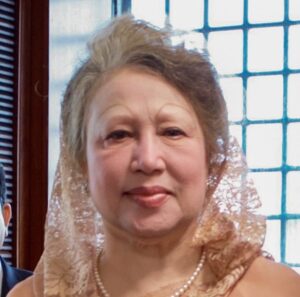
Khaleda Zia, the former prime minister of Bangladesh and a towering figure in the nation’s turbulent political history for over three decades, has died at the age of 80. Zia, who served as the country’s first female prime minister, passed away at Evercare Hospital in Dhaka after a prolonged illness. Her death marks the end of a significant chapter in Bangladesh’s politics, defined by her fierce rivalry with fellow former Prime Minister Sheikh Hasina and her transformation from a reserved political spouse to an uncompromising opposition leader.
The Bangladesh Nationalist Party (BNP), which Zia led for much of her political career, announced her death, stating she died at 6 a.m. on Tuesday morning. The party’s statement described her as their “favourite leader” and requested prayers for her departed soul. Her passing occurs at a critical juncture for Bangladesh, just weeks before anticipated general elections that will be the first since a political revolution toppled her long-time rival last year.
The Political Odyssey of Khaleda Zia
From Tragedy to Political Power
Khaleda Zia’s political journey was born from personal tragedy. She first entered the public eye as the wife of Major General Ziaur Rahman, a war hero who became president of Bangladesh. Following his assassination in a military coup in 1981, Zia was thrust from relative seclusion into the center of national politics. She inherited leadership of the Bangladesh Nationalist Party (BNP), which her husband had founded, transforming from what observers described as a reserved presence into a determined political force in her own right.
Her rise to the premiership in 1991 was a landmark achievement, breaking through a male-dominated political landscape to become the country’s first female head of government. This victory followed the country’s first democratic election in two decades, ending a period of military rule. Zia’s initial administration was noted for several key achievements that shaped modern Bangladesh:
- Restoration of Parliamentary Democracy: Her government successfully amended the constitution with bipartisan support to reinstate the parliamentary system, a crucial step in Bangladesh’s democratic development.
- Advancement of Women’s Rights: She championed policies aimed at improving women’s education and social development, creating opportunities for women in a traditionally patriarchal society.
- Economic Liberalization: Her administration pursued market-oriented economic reforms that helped stimulate growth and development in key sectors of the economy.
- Foreign Policy Reorientation: Zia worked to strengthen relationships with Western nations while maintaining Bangladesh’s traditional non-aligned foreign policy stance.
Her political identity became defined by what supporters called an uncompromising stance on principles, particularly her refusal to participate in elections she deemed unfair. This reputation was cemented during the rule of military leader General Hussain Muhammad Ershad in the 1980s when she boycotted controversial elections, establishing herself as a symbol of democratic resistance.
The Hasina-Zia Rivalry and Political Polarization
For more than three decades, Bangladeshi politics was dominated by the bitter and deeply personal rivalry between Khaleda Zia and Sheikh Hasina. Their competition created a political landscape divided along familial lines—the “Battling Begums”—whose conflict shaped virtually every aspect of the nation’s governance. This rivalry was not merely political but represented two distinct visions for Bangladesh’s identity and future direction.
Zia’s BNP represented a center-right, nationalist platform with an Islamic orientation, while Hasina’s Awami League advocated secular nationalism with socialist leanings. Their alternating periods in power created a pattern of political vengeance where each administration would pursue legal actions against the other, further deepening the nation’s political divide. This polarization reached its peak during Zia’s third term from 2001-2006, which was marked by:
- Heightened Political Violence: The period saw significant clashes between party supporters, creating an atmosphere of political instability and insecurity.
- Allegations of Electoral Manipulation: Opposition parties, including the Awami League, accused Zia’s government of rigging local elections and suppressing political dissent.
- Growing International Scrutiny: Western governments and human rights organizations expressed increasing concern about democratic backsliding and political repression.
- Economic Progress Amidst Turmoil: Despite political challenges, Bangladesh’s economy continued to grow, particularly in the ready-made garment sector which became a global powerhouse.
The bitter feud intensified after Hasina returned to power in 2009 and abolished the caretaker government system—a constitutional provision that had ensured neutral oversight of elections since 1996. Zia boycotted the subsequent 2014 election, claiming it would not be free or fair without this safeguard. This decision effectively created a one-party parliament and marked a turning point toward what critics described as increasingly autocratic rule under Hasina.
Legal Battles, Imprisonment, and Final Years
Corruption Convictions and Political Persecution Claims
Khaleda Zia’s final decade in active politics was dominated by legal battles that she and her supporters characterized as politically motivated persecution. In 2018, she was convicted on corruption charges related to the embezzlement of foreign donations intended for an orphanage trust. She received a ten-year prison sentence, which was later reduced to seven years on appeal. A second conviction in a separate corruption case added three more years to her sentence.
Throughout her legal ordeal, Zia maintained her innocence, asserting that the charges were fabricated by the Awami League government to eliminate its primary political opponent. Her imprisonment sparked international concern, with human rights organizations and foreign governments questioning the judicial independence and political motivations behind her prosecution. The legal proceedings against Zia followed a pattern observed in other countries where anti-corruption campaigns allegedly targeted political opponents.
Her health deteriorated significantly during her imprisonment, with her legal team repeatedly requesting medical treatment abroad, requests that the government consistently denied. The conditions of her incarceration became a focal point for opposition mobilization, with BNP supporters organizing regular protests demanding her release. International diplomatic efforts, particularly from Western nations, quietly advocated for her medical parole or house arrest, but these produced limited results until the political landscape dramatically shifted in 2024.
Release, Failing Health, and Political Transition
Khaleda Zia’s release from prison in late 2024 came not through legal exoneration but through a dramatic political upheaval. Mass anti-government protests, fueled by economic distress and accusations of authoritarianism, ultimately toppled Sheikh Hasina’s government, forcing her into exile. In the transitional period that followed, Zia was granted release on humanitarian grounds due to her deteriorating health condition.
Despite her physical absence from public life, Zia remained the symbolic heart of the BNP during this period of political transition. Her party positioned itself for a potential return to power in the upcoming elections, with Zia’s son, Tarique Rahman, emerging as the heir apparent to the BNP leadership. Her release sparked both celebration among supporters and concern about the stability of Bangladesh’s political institutions, which had become deeply polarized over sixteen years of Awami League rule.
In her final month, Zia’s health continued to decline as she was treated for multiple serious conditions at Evercare Hospital in Dhaka. Her medical team reported she was suffering from kidney damage, heart disease, and pneumonia, among other complications. Despite her critical condition, the BNP had announced in November that she intended to campaign in the upcoming elections, a statement that reflected her enduring symbolic importance to the party even as her physical capacity diminished.
Legacy and Bangladesh’s Political Future
A Complex Political Legacy
Khaleda Zia leaves behind a complex and contested political legacy that reflects the turbulent history of Bangladesh itself. To her supporters, she was a champion of democracy who stood firm against military rule and later against what they viewed as the authoritarian tendencies of the Awami League government. They point to her role in restoring parliamentary democracy, advancing women in politics, and maintaining Bangladesh’s independent foreign policy as her most significant contributions.
To her critics, Zia represented a brand of confrontational politics that deepened divisions in Bangladeshi society and contributed to cycles of political violence and retribution. They cite allegations of corruption during her administrations, questionable electoral practices, and her party’s alliances with Islamist groups as evidence of a flawed political legacy. This dichotomy in how she is remembered reflects the deep polarization that has characterized Bangladeshi politics throughout its independent history.
Internationally, Zia was viewed as a significant figure in South Asian politics who maintained Bangladesh’s traditional non-aligned stance while cultivating relationships with both Western and regional powers. Her government strengthened ties with China and Middle Eastern nations while maintaining working relationships with India and the United States. This balanced approach allowed Bangladesh to secure development assistance from multiple sources while avoiding over-dependence on any single international partner.
The Succession Question and Electoral Prospects
With Khaleda Zia’s passing, the immediate question facing the Bangladesh Nationalist Party is one of leadership succession. Her son, Tarique Rahman, who returned to Bangladesh last week after seventeen years in self-imposed exile in London, is widely expected to assume control of the party. However, his leadership is not without controversy, as he has his own legal challenges and has lived outside the country for nearly two decades.
The BNP faces a critical test in the upcoming elections, which will be the first since the political revolution that ousted Sheikh Hasina. The party must navigate several significant challenges as it prepares for the electoral contest:
- Unifying a Fractured Opposition: The BNP must consolidate support among various anti-Awami League factions while presenting a coherent alternative governance platform.
- Addressing Legacy Issues: The party needs to distance itself from past allegations of corruption and political violence while honoring Zia’s legacy.
- Appealing to Younger Voters: With a significant portion of Bangladesh’s population under 30, the BNP must develop policies that address youth concerns about employment, education, and political participation.
- Managing International Perceptions: The party must reassure foreign governments and investors about its commitment to democratic norms and economic stability.
The electoral landscape has shifted dramatically since the BNP last held power. New civil society movements, digital activism, and changing demographic patterns have created a more complex political environment. Additionally, the Awami League, though currently out of power, retains significant organizational strength and will likely mount a vigorous campaign to return to government.
Regional Implications and International Reactions
Khaleda Zia’s death has elicited responses from regional powers and international partners who have watched Bangladesh’s political evolution with keen interest. Indian Prime Minister Narendra Modi expressed deep sadness at her passing and paid tribute to her contributions to Bangladesh’s development and India-Bangladesh relations. This response reflects India’s strategic interest in maintaining stable relations with its neighbor regardless of which party holds power in Dhaka.
Other regional players, including China and Pakistan, have also monitored developments closely. China, which has invested heavily in Bangladesh’s infrastructure through its Belt and Road Initiative, values political stability above partisan allegiance. Pakistan maintains historical connections with Bangladesh (formerly East Pakistan) and watches its political developments with particular interest given their shared history.
Western governments, particularly the United States and United Kingdom, have consistently advocated for democratic processes and free elections in Bangladesh. They have expressed concern about democratic backsliding in recent years and are likely to closely observe whether the upcoming elections meet international standards for fairness and transparency. The European Union, a significant trade partner for Bangladesh’s garment industry, similarly emphasizes the importance of political stability and respect for labor rights.
Conclusion
Khaleda Zia’s death marks the end of a defining era in Bangladeshi politics. Her journey from political widow to the nation’s first female prime minister, through periods of power and imprisonment, mirrors the turbulent democratic development of Bangladesh itself. Her legacy is inextricably linked with that of her rival, Sheikh Hasina, their decades-long feud having shaped the nation’s institutions, political culture, and international relationships.
The immediate political future of Bangladesh now hinges on several uncertain factors: the BNP’s ability to transition to new leadership under likely successor Tarique Rahman, the conduct of the upcoming elections, and the potential for either continued polarization or unexpected reconciliation in the country’s political landscape. What remains clear is that Khaleda Zia’s impact on Bangladesh will be debated and analyzed for generations, just as the nation continues to navigate its path between democracy and authoritarianism, development and inequality, secularism and religious identity.
As Bangladesh prepares for its next chapter, the shadow of the “Battling Begums” will undoubtedly linger over its politics. The challenge for the nation’s democratic institutions will be to transcend the personal rivalries that have dominated its politics for so long and build a system based on principles rather than personalities. In this endeavor, the complex legacy of Khaleda Zia—both her achievements and her controversies—will serve as a crucial reference point for understanding what Bangladesh has been and what it might yet become.