

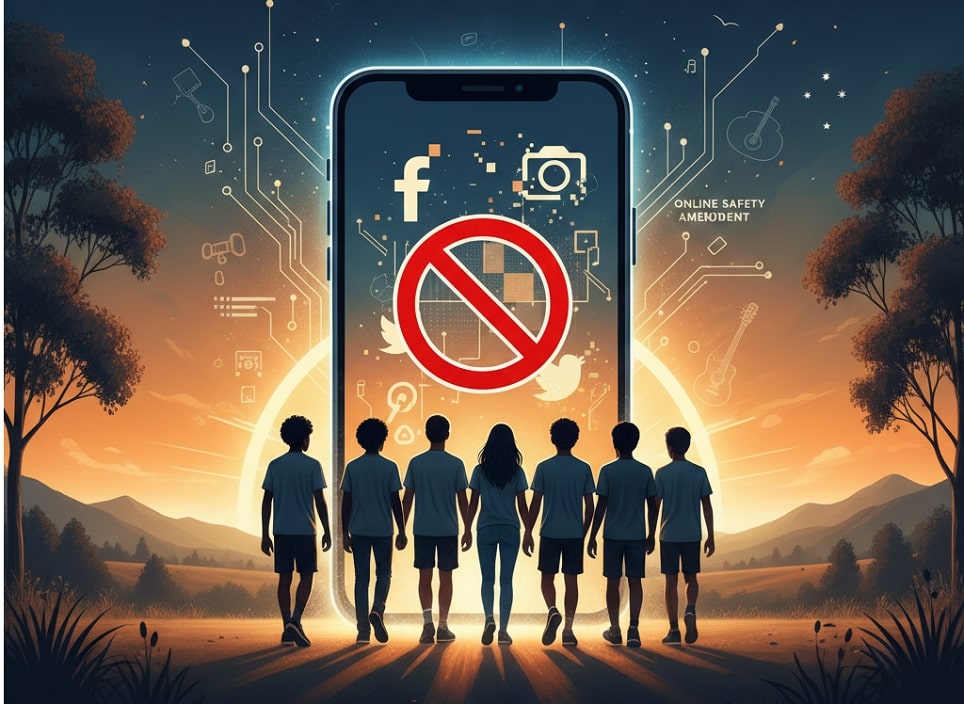
The Australian government has initiated one of the world’s most consequential and closely watched legislative experiments in digital regulation: the Mandatory Age Verification for social media users. Effective December 10, 2025, the Online Safety Amendment (Social Media Minimum Age) Act 2024 (SMMA) fundamentally shifts the responsibility for child safety online from parents and users to the global technology platforms themselves. This landmark legislation, often referred to simply as the social media ban for under-16s, requires major age-restricted social media services to take “reasonable steps” to prevent Australian residents under the age of 16 from creating or maintaining an account.
The move is a direct political response to escalating global concerns regarding the detrimental effects of social media algorithms, harmful content exposure, and addiction on the mental health and psychological development of adolescents. By implementing a mandatory minimum age of 16—a global first on this scale—Australia is challenging the operational status quo of tech giants like Meta, TikTok, and Google, who previously relied largely on self-declaration and minimal enforcement of their own 13+ age policies. The law has immediately put Australia at the forefront of digital regulation, turning the nation into a live laboratory for how a comprehensive age assurance framework can be enforced in an interconnected digital world.
While hailed by child advocates, parents, and numerous mental health experts as a necessary intervention to reclaim childhood and foster genuine development, the legislation has sparked significant controversy. The debate centers on the practical efficacy of age verification technology, the thorny issue of privacy and data collection required for assurance, and the political implications concerning freedom of speech and movement to less-regulated, potentially more dangerous, online spaces. As platforms scramble to implement complex technical solutions and millions of accounts are affected, the world watches closely to determine if a national government can successfully draw a boundary between technology and youth development in the 21st century.
The Legislative Framework: Understanding the Social Media Minimum Age (SMMA)
The Online Safety Amendment (Social Media Minimum Age) Act 2024 is not standalone legislation but an amendment to the existing Online Safety Act 2021 (OSA), incorporating a new Part 4A that establishes the Social Media Minimum Age (SMMA) framework. Passed by the Australian Federal Parliament, this law aims to close the legal gap that previously allowed children as young as 13 to access platforms that were demonstrably designed for older adolescents or adults. The law specifies that its obligations apply to “age-restricted social media platforms,” a definition purposefully broad enough to cover services whose primary purpose is to enable online social interaction and content sharing between multiple users.
A critical feature of the SMMA is the placement of legal liability. Crucially, the law imposes penalties solely on the platform providers, not on children or their parents. If an age-restricted platform fails to take “reasonable steps” to prevent an under-16-year-old Australian resident from having an account, the company faces significant monetary punishment. These penalties can be severe, with potential fines reaching up to 30,000 penalty units, currently equivalent to approximately AUD $9.9 million, or up to $49.5 million in court proceedings for systemic failures in compliance. This high financial risk ensures that companies are incentivized to invest heavily in robust age assurance technologies and processes, moving beyond simple click-through consent.
The legislation defines “age-restricted social media platforms” to include well-known giants such as Facebook, Instagram, Threads, TikTok, X (formerly Twitter), YouTube, Snapchat, Reddit, Twitch, and Kick. However, the law intentionally excludes platforms deemed essential for education, health, or private messaging, such as WhatsApp, Messenger Kids, Kids Helpline, and Google Classroom, recognizing the need to balance safety with necessary communication tools. The power rests with the Minister for Communications and the eSafety Commissioner to narrow, broaden, or otherwise adjust the list of restricted services as the digital landscape evolves, ensuring the framework remains agile and targeted.
The Rationale: Public Health and Digital Harm
The impetus for the SMMA stems from a growing body of evidence and public outcry linking early and unsupervised social media exposure to significant harms in young people. Australian officials, spurred by global research and high-profile advocacy, framed the law not as a ban, but as a necessary “social media delay,” akin to age restrictions already placed on alcohol, tobacco, and driving. The central goal is to protect adolescents during their most vulnerable developmental phase, from roughly 13 to 16 years old, allowing them critical time for emotional and cognitive growth before confronting the intense pressures of algorithmic social interaction.
Key figures, including Australia’s eSafety Commissioner Julie Inman Grant, have consistently emphasized that the law targets the deliberate, powerful design features embedded in platforms—such as opaque algorithms, endless scrolling, and notification loops—that are optimized for engagement and addiction, often to the detriment of young users. The government’s position was heavily influenced by reports detailing how social media platforms can amplify anxiety, foster unhealthy social comparisons, and increase the risk of cyberbullying and exposure to harmful, self-injurious, or explicit content. This narrative crystallized around the idea of protecting children from “powerful, unseen forces” that compromise their health and wellbeing.
The law’s foundation rests on clinical and psychological insights. Experts quoted during the legislative hearings highlighted the benefits of delaying exposure to the performative social demands and validation-seeking behaviors inherent in these platforms. Dr. Ellese Ferdinands of the University of Sydney, for instance, noted that the delay offers a positive step for teen mental health by reducing the breeding ground for comparison and the subsequent mental health struggles, regardless of age. By limiting access until age 16, policymakers aim to give young Australians a crucial two to three years of development free from the most intense digital pressures.
This perspective is strongly supported by parents and educators who have witnessed firsthand the corrosive effects on youth development. The legislative push gained significant momentum following advocacy efforts that drew attention to the personal tragedies of families who lost children to mental illness and suicide, which they believed were aggravated by their children’s experiences on social media. The government’s messaging, backed by Prime Minister Anthony Albanese’s direct appeal to students to utilize their newfound free time for sports, instruments, or face-to-face interaction, underscores the deep commitment to a holistic approach to child wellness, prioritizing real-world engagement over constant digital scrolling.
The Technological Challenge: Mandatory Age Assurance and Verification
The success of the SMMA hinges entirely on the ability of social media companies to implement effective, accurate, and privacy-preserving age assurance systems. The legislation imposes a complex technical hurdle: platforms must be able to verify the age of Australian users without compelling them to use government-issued identification, such as Digital ID or a driver’s license, due to privacy concerns.
Verification Methods and Privacy Concerns
To comply, platforms must deploy a layered approach to age assurance, combining multiple methods. The law requires that platforms must always offer a “reasonable alternative” to the collection of government ID, a measure designed to safeguard user privacy and prevent mass collection of highly sensitive state-issued documents. These reasonable alternatives have manifested in several ways across the industry:
- Facial Age Estimation Technology: This method involves users taking a short video or selfie, which is analyzed by a third-party service provider (like Yoti or k-ID) to estimate their age range. The platforms are generally restricted to receiving a “yes/no” result indicating whether the user is over the age of 16, rather than the specific biometric data itself. This attempts to balance compliance with minimizing data retention risks.
- ConnectID and Bank Verification: Some platforms, like Snapchat, offer the option to verify age through a connection with an Australian bank account via services like ConnectID. This leverages existing, verified financial data to prove age, often without directly sharing sensitive bank details with the social media company. This method relies on the high level of identity assurance already built into the banking system.
- In-House Signals and Proprietary Software: Many companies initially rely on proprietary software to infer a user’s age based on historical data, known as ‘signals.’ These signals can include the age of the account, usage patterns, types of content engaged with, and account creation dates. While less invasive, these methods have historically been criticized for their inaccuracy and for being primarily designed for advertising rather than strict legal compliance.
- Device-Level Age Assurance: Companies like Apple are pushing a different, privacy-focused approach. Apple has introduced a ‘Declared Age Range API’ that allows parents to share a broad, verified age bracket (e.g., ‘under 16’) through the operating system, rather than the platform collecting the specific date of birth. This shifts the verification point to the device or app store, minimizing the need for platforms to store sensitive personal information.
- Parental Attestation and Group Verification: Although parental consent does not override the ban, platforms are exploring mechanisms for adults to vouch for a child’s age in certain grey areas, or using groups of trusted users to confirm identity. However, the SMMA’s strict interpretation means that an under-16 cannot hold an account in their own right, regardless of parental approval.
The handling of personal information during this process is tightly governed by Part 4A of the OSA and the broader Privacy Act 1988. Providers must only use collected information (such as name, date of birth, location data, and biometric data) for the explicit purpose of age assurance. Any unauthorized use or data breach is considered a serious interference with privacy, potentially leading to additional severe penalties beyond the non-compliance fines.
The Accuracy and Circumvention Dilemma
Despite the technological efforts, experts and the eSafety Commissioner herself acknowledge that no age verification solution is likely to be 100 percent effective. This inherent technical limitation creates a significant dilemma for the law’s enforcement and long-term viability. Research has shown that age estimation technologies, particularly those using biometric analysis, can have error rates of two to three years, meaning a 14-year-old could easily be misclassified as 16 or 17, and vice versa. When deployed across millions of Australian users, even a small error rate can translate into tens of thousands of wrongful exclusions or dangerous inclusions.
Furthermore, the expectation of widespread circumvention is high. Teenagers are known to be digitally savvy and motivated to find ways around restrictions. Common methods anticipated by authorities and observed in the lead-up to the ban include:
- Using Parental Credentials: Children may simply log into accounts created under a parent’s name and age, effectively bypassing the platform’s verification mechanisms, as the law does not penalize parents or children for access.
- Uploading Fake or Altered Identification: Though platforms are required to offer alternatives, teens who opt for ID verification may attempt to use fabricated or digitally altered documents to pass the age check, leveraging readily available online tools.
- Migrating to Unregulated Platforms: A major concern raised by digital literacy experts like Dr. Brittany Ferdinands is the risk of pushing youth activity “underground.” Teens may migrate to smaller, less-regulated social apps, international services, or highly private group chats that fall outside the SMMA’s definition of an “age-restricted platform,” thus potentially exposing them to less secure environments without the mandated safety features.
- VPN Usage: By utilizing Virtual Private Networks (VPNs), Australian teens can mask their geographic location, making it appear as though they are accessing the service from a country not subject to the SMMA, thereby avoiding the mandatory age assurance check for Australian residents.
This challenge has led to criticism from digital rights groups and even some tech executives, who argue that the regulation is poorly designed and will not achieve its intended safety goals. Instead, they advocate for solutions focused on universal safety standards, digital literacy education, and parental controls implemented at the device or operating system level, which they believe offer a more robust and less privacy-invasive approach than platform-level age verification.
Industry Compliance and Corporate Response
In the lead-up to the December 10 deadline, the reaction from Big Tech was a mixture of initial political opposition followed by rapid, large-scale implementation efforts to ensure legal compliance and avoid crippling fines. While companies globally criticized the law as being rushed, impractical, and invasive, the threat of multi-million dollar penalties forced swift action.
Big Tech’s Compliance Measures
Major age-restricted platforms announced specific measures targeting their Australian user base:
Meta (Facebook, Instagram, and Threads): Meta was among the first to act, announcing that its platforms would begin deactivating accounts belonging to Australian users under the age of 16 weeks before the final deadline. Impacted users were given the option to download all their content—photos, posts, and contacts—before the account was locked or permanently deleted. Meta also provided an appeal process, often relying on third-party age verification methods like Yoti or government ID submission, for users who believed their age had been incorrectly flagged. Despite their compliance, Meta publicly lobbied for alternative solutions, arguing that age verification should occur once at the app store level, rather than repeatedly across every platform.
Snapchat: Snap Inc. voiced strong disagreement with the classification of its platform as an age-restricted service under the SMMA, arguing that its primary function is private messaging among known friends. Nonetheless, the company committed to compliance. Snapchat began locking accounts of under-16 users, providing a three-year window for these teens to download their data or to verify their age once they turn 16 and reinstate the account. Snapchat was also one of the first to detail its layered age verification process, offering ConnectID, photo ID scanning via k-ID, and facial age estimation.
TikTok and YouTube (Google): TikTok and YouTube, both massively popular with the target age group, implemented similar phased deactivation processes. TikTok stated it would deactivate the accounts of Australian users aged 13 to 15, ensuring content previously published by them would no longer be visible to other users. Google, owner of YouTube, expressed concerns that the requirement for users to access YouTube without an account would undermine existing safety features and parental controls, yet confirmed it would comply with the new regulation and prevent under-16s from holding accounts on the main platform.
Even smaller or newer platforms, such as the livestreaming service Kick and the X alternative Bluesky, announced they would comply, despite some being initially deemed “low risk” by the eSafety Commissioner. This near-universal commitment to compliance, despite corporate resistance, highlights the perceived success of the Australian government’s strategy of setting high financial penalties to force systemic change across the entire industry.
Exemptions and the Expanding Scope
The SMMA framework is designed to be living legislation, capable of adapting to the rapid evolution of digital services. While the initial list of age-restricted platforms is comprehensive, the exemption of several widely used services remains a significant point of discussion. The eSafety Commissioner categorized services primarily used for private messaging, education, or gaming as exempt, based on a risk assessment that they pose fewer acute harms related to algorithmic addiction and public comparison.
The platforms currently exempt include: WhatsApp, Messenger (standalone service), Discord, Pinterest, Roblox, Steam, and Google Classroom. These exemptions are based on the core functionality of the service. For instance, while Roblox and Discord are social, they are classified primarily as gaming and communications platforms, respectively, which regulators currently assess as posing different risk profiles than the broadcast-centric nature of TikTok or Instagram. This distinction is crucial, as critics fear that the ban will simply funnel underage activity into these still-social, but currently unregulated, spaces. The legislation explicitly allows for the regulator to review and update this list, meaning platforms like Roblox could potentially be added if their social features are deemed to pose a comparable risk to those that are restricted.
The Australian approach distinguishes between services that require user accounts for personalized, public-facing social interaction and those used for closed-group, utilitarian, or educational purposes. This deliberate targeting ensures that the core mission—delaying exposure to the most damaging design features—remains intact, while maintaining essential digital access for children’s education and private communication. The ongoing monitoring ensures that the scope is not static but dynamically responsive to emerging online trends and documented harms. The success of the SMMA will be partly measured by its ability to prevent the targeted user base from simply migrating to the closest available exempt platform.
National and Global Reactions to the Ban
The implementation of the SMMA has been met with a complex array of reactions both within Australia and across the international community, highlighting a deeply divided perspective on governmental intervention in the digital lives of children. The ban has ignited a fierce debate involving civil rights groups, parents, educators, and the young people directly affected.
Youth and Parental Sentiment
Surveys conducted in the weeks leading up to the ban revealed a stark dichotomy in sentiment. Among the Australian public, there is broad support for the law’s intent, with polls indicating that a significant majority of parents and teachers favor the move, viewing it as a long-overdue public health measure. Parents, in particular, expressed hope that the delay would lead to “better, more authentic relationships” for their children and a return to face-to-face social interaction reminiscent of pre-digital childhoods. They praise the government for intervening where they felt they lacked the tools or authority to enforce limits themselves against platform design optimized for maximum engagement.
However, the reaction from the teenagers directly impacted by the ban is largely skeptical and negative. In a survey by the Australian Broadcasting Corporation, a large majority of 9- to 16-year-olds expressed doubt that the ban would work and affirmed their intent to continue using social media. This intention is manifested in the reported rush to alternative, smaller apps, and the widespread attempts to circumvent verification processes, often with the tacit or explicit support of their parents. Many young people feel the law infringes upon their rights to political communication, self-expression, and connection, especially as they are often digitally native and rely on these platforms for educational resources and maintaining peer relationships.
Furthermore, the legislation has faced a legal challenge. The Digital Freedom Project announced its intention to commence legal action in the High Court of Australia against the new laws, alleging they violate the implied constitutional right to political communication. This challenge underscores the view that the sweeping nature of the ban restricts the ability of young people to participate in political discourse and access information, a right deemed fundamental in a modern democracy, regardless of age. The outcome of this legal test will be a crucial factor in determining the ultimate scope and longevity of the SMMA.
Australia as a Global Policy Laboratory
The most enduring consequence of the SMMA may be its role as a global benchmark for digital regulation. Australia has effectively positioned itself as the world’s first major nation to tackle the problem of algorithmic harm through mandatory age verification enforced by platform liability. As a result, the global legislative community is closely monitoring the rollout, the technical success rate, and the social outcomes.
Governments across Europe, including in Denmark and the United Kingdom, and state legislatures in the United States, have expressed increasing interest in implementing similar age-based restrictions, frustrated by the slow pace of self-regulation within the tech industry. For these jurisdictions, the Australian experience serves as a crucial proof of concept: it demonstrates that it is technically and legally possible for a government to compel global tech companies to fundamentally change their operating procedures to protect a specific demographic. Professor Tama Leaver, an internet studies expert, noted that the ban is very much the “canary in the coal mine,” signaling a new era where governments are willing to intervene directly and assert their sovereignty over digital spaces operating within their borders.
The specific mechanisms of age assurance being trialed in Australia—the layered approach, the prohibition on mandatory government ID, and the reliance on third-party verification—will provide valuable data for international lawmakers crafting their own proposals. The ability of tech firms to comply quickly, even if reluctantly, highlights the effectiveness of massive financial penalties as a regulatory tool. The global dialogue has irrevocably shifted from whether governments should regulate social media access for minors to how they can do so most effectively, ethically, and securely, using the Australian model as the primary point of reference and critique.
Conclusion
The commencement of Australia’s Social Media Minimum Age framework marks a profound moment in the history of digital policy. It is an unreserved declaration that the mental health and developmental wellbeing of adolescents supersede the business models of global technology platforms. By mandating age verification and placing the financial and legal burden of compliance squarely on the platforms, the Australian government has taken a pioneering and highly aggressive step to shield its youth from the documented harms of algorithmic social media.
While the legislation is groundbreaking in its intent and scope, its ultimate success remains dependent on overcoming two substantial hurdles: the technical reliability of age assurance systems and the challenge of user circumvention. The enforcement mechanism is rigorous, threatening fines up to nearly $50 million for non-compliance, yet the reality of keeping digitally savvy teenagers off popular global services is complex and fraught with the risk of pushing activity into less visible, unregulated corners of the internet. Nevertheless, the SMMA has succeeded in forcing Big Tech to pivot from resistance to compliance and has immediately provided a crucial blueprint for other governments grappling with the digital dilemma. Australia’s social media delay is more than a national law; it is a global experiment in regulatory power that will shape the future of childhood in the digital age, influencing public health policy and tech governance for decades to come.
